
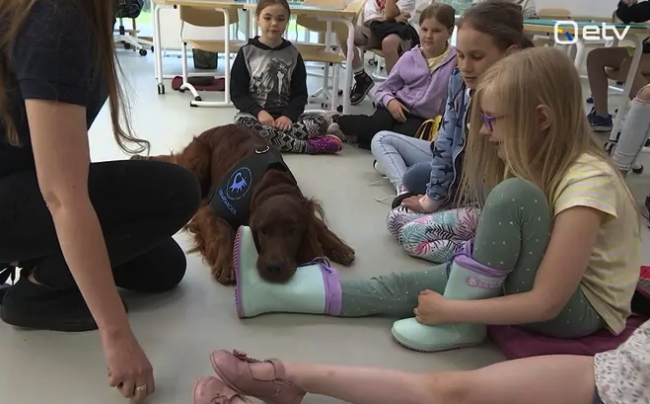
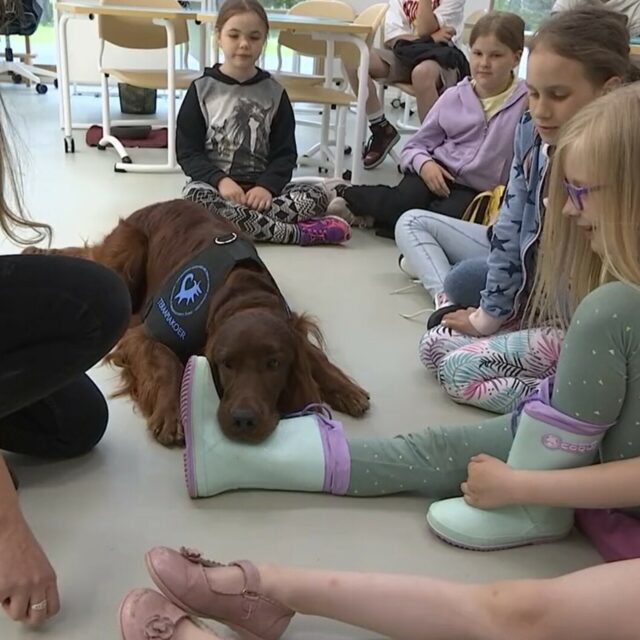
Last week, six therapy dogs passed their professional qualification exams and will begin working with children in schools and therapy institutions in late spring in Estonia. Luu passed their therapy dog exam over the weekend and is now working at Kuusalu High School, around half an hour east of Tallinn.
“They help reduce stress,” Reet Reinsalu, a Kuusalu High School teacher and study dog handler, stated. If a child has a scarier assignment — performing in front of the class, reciting a poem — it may be easier to do so for the dog.
“As a class teacher, what I look at is if there is some topic where I see that involving the dog would be a help to the kids, then I can teach the lesson in such a way that studying dog Luu is along with me and helping.”
“I learned about clickers — I didn’t know something like that even existed,” said Gerda, a student.
“I learned that dogs and people aren’t as different as I used to think,” classmate Mirjam added.
For nearly ten years, study and therapy dog services have been available in various parts of Estonia. It is simpler for people who require assistance to interact with dogs, according to Maarja Tali, a board member of the Estonian Association of Assistance and Therapy Dogs (EATKÜ).
“By inviting a dog onto the team, maybe difficult, maybe painful process becomes an enjoyable game,” Tali explained. “And these clients are often people who have a hard time communicating with other people.”
Adults with speech difficulties, extremely young children, and people with severe mental health issues are among them, she said. “It often happens that it’s easier for them to make contact and connect with an animal or dog.”
Jack Russel Elli, 3.5-year-old, works at the TegevusTe Developmental Therapy Center in Tallinn’s Nõmme District, where he and his four-legged coworkers assist children of diverse ages and origins.
“We offer dog-inclusive therapy as well here," said Kristi Viimsalu, an occupational therapist at TegevusTe. “I think it’ a fantastic opportunity not available elsewhere.”
The success of the program depends on the dog’s favorable relationship with the young patient. “We have to assess the child and their needs well,” Viimsalu explained.
“Do they need a big and calm or rather an active and enthusiastic dog? What are the goals of the therapy, what should a dog know how to do, and what support can they provide the child?”
Anyone can theoretically train their dog to work as a therapy dog. Tallinn University (TLÜ) will begin providing a micro degree program in human-animal interaction this fall.